
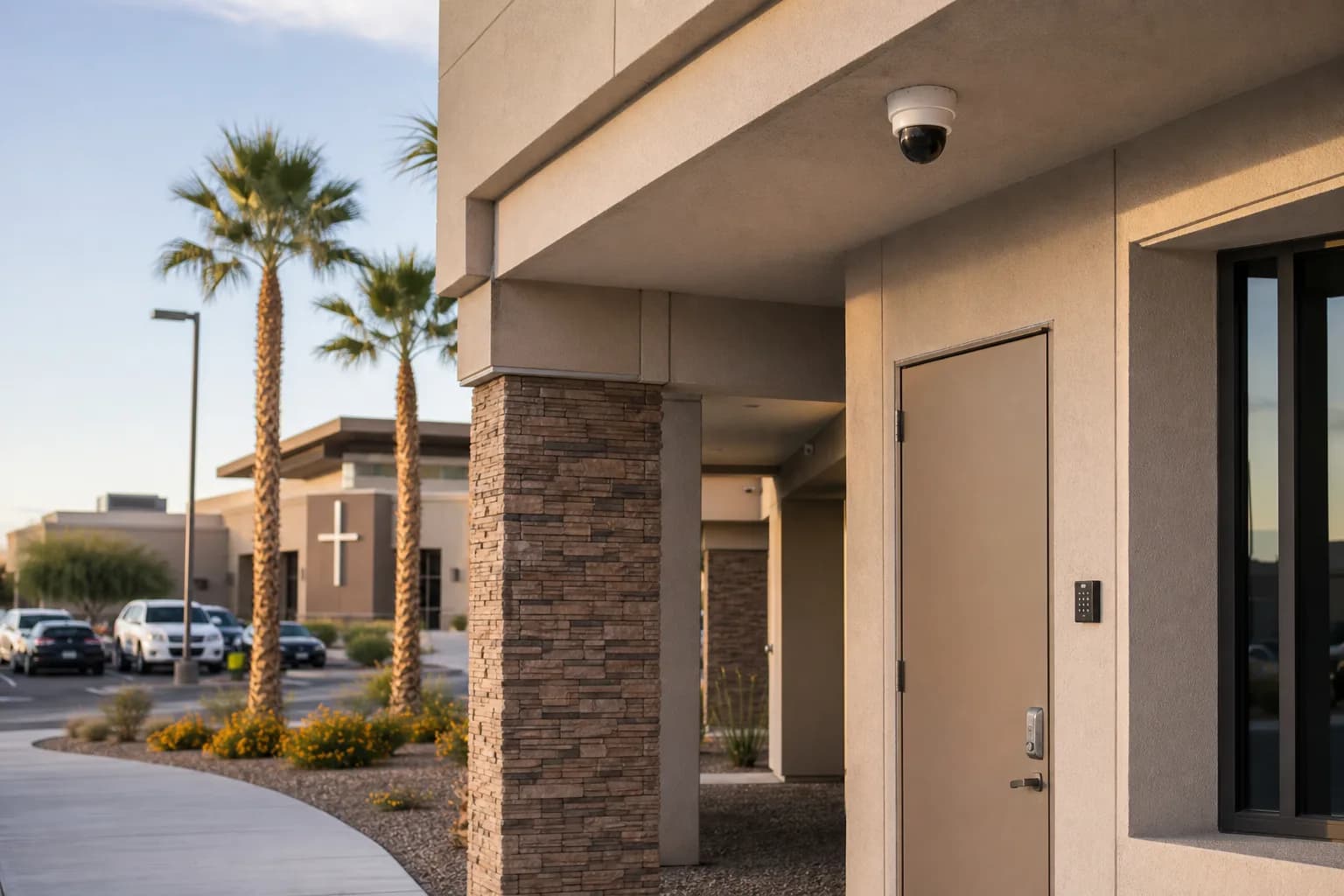
A church security systems Las Vegas congregation can trust has to solve two problems at once: staying open and welcoming during services, funerals, weddings, and weekday programs, and protecting staff, volunteers, children, donations, and property during the many hours the building sits empty or lightly staffed. ASAP Security works with Las Vegas Valley churches, temples, and other houses of worship to design monitored alarm systems, cameras, access control, and locksmith support that fit how a congregation actually uses its building — without turning the lobby into a checkpoint.
- Houses of worship need layered protection: alarms for after-hours, cameras for entrances and parking, access control for restricted rooms, and locksmith support for staff turnover
- Security should support a welcoming front door, not replace it — most controls belong on offices, storage, and back-of-house areas
- Plan around your congregation's real patterns: service times, weekday programs, and rooms that need restricted access
- Bring the security plan to your board or leadership team the same way you would any other facilities decision
Church Security Systems Las Vegas Congregations Can Trust
A retail store or office can lock its doors and turn away anyone without an appointment. A church, temple, or other house of worship generally can’t operate that way — the building needs to stay approachable to visitors, families, and the public during services and events. That difference changes how a security plan should be built.
Instead of one blanket policy, ASAP Security’s commercial security and security camera services for congregations typically combine a few distinct layers: a monitored alarm for after-hours protection, cameras that cover entrances and parking without watching over the sanctuary itself, access control on the rooms that actually need it, and locksmith support so staff and volunteer turnover doesn’t turn into a rekeying project every time. For a broader look at how these same layers apply to any Las Vegas organization, see the Las Vegas business access control guide. Our dedicated church and temple security page covers the full range of services available to congregations across the valley.
Balancing an Open, Welcoming Front Door With Real Protection
The goal isn’t to make a sanctuary feel guarded. It’s to be intentional about which parts of the building stay open to everyone and which parts don’t.
Most congregations land on a similar pattern:
- Open during services and events: Main entrances, lobbies, sanctuaries, and fellowship areas stay accessible to the public during posted hours.
- Staff and volunteer only: Offices, classrooms with children present, AV and equipment rooms, and storage closets are limited to people with an active role.
- Restricted: Safes, donation-counting rooms, server or network closets, and medication storage (for schools or daycares operating on-site) get the tightest controls.
Writing this down — even as a simple list reviewed once a year — gives greeters, ushers, and staff a shared understanding of what “open” and “restricted” actually mean in your building, and it gives your security provider a clear scope to design around.
Layer 1: Monitored Alarm Systems for After-Hours Protection
Most houses of worship are unoccupied far more hours than they’re in use. A church that holds services on Sunday morning and a midweek program is empty or nearly empty the rest of the week — evenings, overnight, and many weekday afternoons.
A professionally monitored alarm system covers those gaps. If a door, window, or motion sensor is triggered while the building should be empty, the monitoring center contacts a designated leader or staff member and can request law enforcement dispatch. Coverage typically extends to:
- Exterior doors, including side and rear entrances used for deliveries or staff parking
- Ground-floor windows and any accessible second-story access points
- Interior motion sensors in offices, storage areas, and rooms with valuable equipment
- Panic or duress options for staff working alone during office hours
Because service schedules and program calendars vary by congregation, the system should be easy for your own staff to arm and disarm on your schedule — not locked into a single fixed routine.
Layer 2: Security Cameras for Entrances, Parking Lots, and Common Areas
Cameras placed at entrances, parking lots, and exterior common areas do two things: they deter opportunistic theft and vandalism, and they give leadership and law enforcement something to review if an incident does happen.
For most congregations, the useful coverage areas are:
- Main and secondary entrances
- Parking lots and drop-off areas, especially where children are picked up or dropped off
- Donation drop boxes or collection points, if used
- Exterior storage, equipment, or utility areas
Cameras generally don’t need to cover the sanctuary or worship space itself — the goal is protecting the property and the people arriving and leaving, not monitoring the service. Footage retention and who has viewing access are policy questions worth deciding with your leadership team up front, alongside the Las Vegas security camera options available for a property your size.
Layer 3: Access Control for Offices, Nurseries, and Donation Storage
Access control is where “welcoming” and “restricted” areas actually get separated in practice. A keypad or card/fob reader on a door lets you grant entry to staff and approved volunteers and remove it instantly when someone’s role changes — without rekeying a lock.
Common places congregations use access control:
- Church and administrative offices
- Nursery and children’s ministry areas, where controlling who can pick up which child matters as much as building security
- AV, network, and equipment rooms
- Donation counting rooms or safes
The Las Vegas business access control guide walks through how to evaluate credential types (keypad codes, fobs, or mobile credentials) and cloud versus on-premise management — the same questions apply whether the building is a church office suite or a commercial one.
Layer 4: Locksmith Support for Staff and Volunteer Turnover
Churches and temples often rely heavily on volunteers, and volunteer rosters change more often than a typical office staff. If access is still controlled with a physical key, every departure raises the same question: does this person still have a working key to the building?
This is where locksmith support becomes part of the security plan rather than an occasional emergency call. ASAP Security’s Nevada-licensed locksmiths (License LV L0600194-E107635) can rekey affected doors after a volunteer or staff departure, install or service master-key systems for multi-building campuses, and respond to lockouts when a leader is locked out before an early-morning service. Pairing key-controlled doors with electronic access control on the highest-priority rooms — offices, nursery, storage — reduces how often a physical rekey is needed at all. The guide to professional locksmith security services covers how rekeying, lock repair, and replacement differ, which is useful background before your next volunteer transition.
If you’re locked out or need an urgent locksmith response, call (702) 870-8880 directly rather than waiting on a web form.
Planning Security Around Service Times and Programs
Every congregation has its own rhythm — a main Sunday or Friday service, midweek programs, seasonal events, and quieter weekday hours when only a handful of staff are present. A security plan should follow that rhythm rather than force a single fixed schedule onto the building.
Practical planning questions to walk through with your provider:
- Which doors need to unlock automatically before a service and lock again afterward?
- Who is responsible for arming the alarm at the end of the night, and is there a backup?
- Do weekday programs (choir practice, small groups, a preschool or daycare) need different access hours than weekend services?
- Are there large seasonal gatherings that temporarily need more open access, and who resets the building afterward?
None of these answers are the same for every congregation, which is why a walkthrough of your specific building and schedule matters more than a generic package.
Building a Security Plan With Your Congregation’s Leadership
Security decisions for a house of worship usually involve more than one person — a pastor, rabbi, imam, board, or facilities committee often needs to weigh in before equipment gets installed or a budget gets approved. Treating this like any other facilities decision helps:
- Document current doors, existing hardware, and known problem areas (a door that doesn’t latch, a key that’s been lost, a camera blind spot).
- Separate “must have now” items (a functioning alarm, controlled access to the nursery) from longer-term projects (a full camera upgrade, a multi-building master-key system).
- Identify who can approve emergency work versus planned projects, so a locksmith or technician isn’t left waiting on an answer during a lockout.
- Review the plan periodically as staff, volunteers, and building use change.
This mirrors how other Las Vegas organizations with a board or association structure approach the same decisions — the HOA access control board guide walks through a similar governance process for community associations, and much of it translates directly to a church or temple board.
Frequently Asked Questions
Will security equipment make our building feel less welcoming?
It doesn’t have to. Most of the equipment described here — alarm sensors, access control on offices and storage, cameras on entrances and parking — is placed on the rooms and areas that were never meant to be open to the public in the first place. The sanctuary, lobby, and public entrances stay exactly as open as your congregation wants them during services and events.
Do we need access control if we already lock up at night?
A nightly lock-up protects the building after hours, but it doesn’t address who can get into the nursery, office, or storage room during the day, or what happens when a volunteer with a key stops attending. Access control and locksmith rekeying address that daytime and turnover gap that a simple lock-and-alarm routine doesn’t cover.
How do we handle security for a multi-building campus?
Larger campuses with a sanctuary, education building, and administrative offices typically use a combination of a master-key or electronic access system so staff can move between buildings they’re authorized for, paired with cameras and alarm coverage on each structure. A walkthrough of the campus is the best way to scope this correctly rather than assuming one building’s plan fits all of them.
Can you work with a small congregation on a limited budget?
ASAP Security works with houses of worship of different sizes, from small neighborhood chapels to larger multi-building campuses. A walkthrough lets us recommend a system scaled to your building and priorities rather than a one-size package.
Talk to ASAP Security About Your Congregation’s Building
ASAP Security is locally owned and has served Southern Nevada since 2003. The company is a First Alert PRO / Resideo partner, holds Nevada Contractor License #0058622 and Locksmith License LV L0600194-E107635, maintains a BBB A+ rating, and is based at 3170 Polaris Avenue, Suite 4, Las Vegas, NV 89102.
For an urgent lockout, call (702) 870-8880. For a walkthrough of your sanctuary, offices, and campus, request a restrained, no-pressure quote and bring your current door and key list — it’s the fastest way to get a plan that fits how your congregation actually uses the building.
Related Articles
Access Control Systems for Las Vegas Businesses: What You Need to Know in 2026
7 min read
Why You Need Locksmith Security Services in Las Vegas, NV
5 min read
Business Security Services: Top 5 Mistakes Las Vegas Businesses Make
6 min read
HOA Access Control Systems Las Vegas: A Board Guide
10 min read