
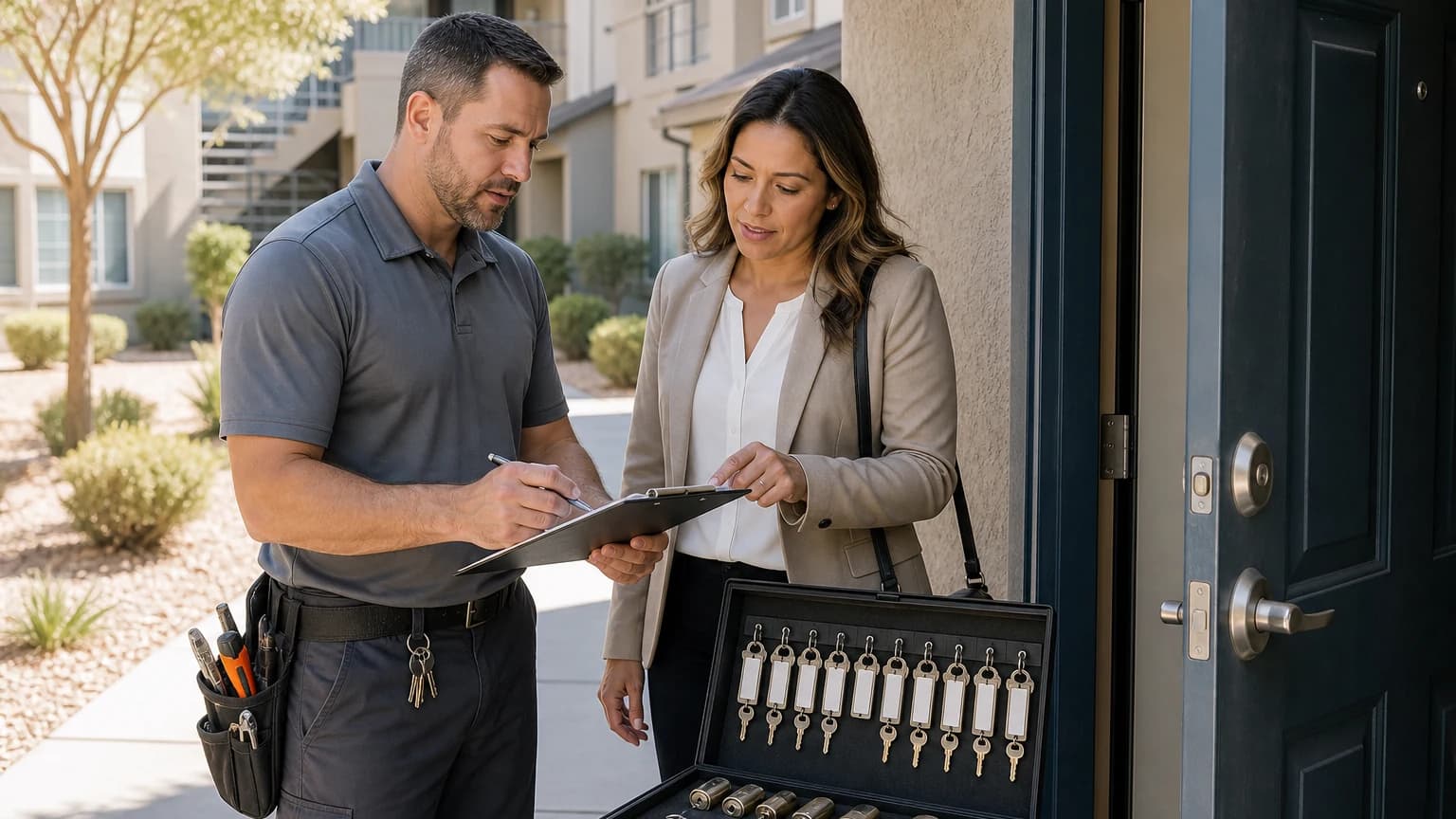
A property management locksmith Las Vegas teams can use consistently should be more than a phone number attached to a turnover work order. The relationship works best when the manager and locksmith agree on the openings covered, who may authorize work, how keys are controlled, what must be documented, and how urgent lockouts differ from planned rekeys or hardware projects.
ASAP Security’s Las Vegas locksmith services support residential, commercial, and managed-property lock work under Locksmith License LV L0600194-E107635. For portfolio coordination, the company’s property manager security services provide the industry-specific starting point. This guide focuses on building a repeatable locksmith service scope; the separate rental property turnover security checklist covers the broader review of locks, alarms, cameras, codes, and tenant handoff.
- Inventory managed openings and existing lock hardware before standardizing service requests
- Separate planned rekeys, repairs, replacements, lockouts, and larger access projects in the work order
- Name the people who may request service, approve added work, and receive keys or records
- Use property and opening identifiers without exposing sensitive key or access details in general tickets
- Require a closeout record that matches the completed work, delivered keys, tests, and unresolved items
Property Management Locksmith Las Vegas Teams: Define the Service Lane
Begin with the operating situations the locksmith may be asked to handle. A single-family rental in Summerlin, a multifamily property near central Las Vegas, and a mixed-use building in Henderson may have different doors, hardware, occupants, management contacts, and access procedures. The service lane should make those differences visible before a technician arrives.
Group requests by outcome:
- Planned rekey: Change which key operates a serviceable cylinder after an approved event.
- Repair: Restore normal lock, latch, closer, strike, or door-hardware operation after inspection.
- Replacement: Install approved hardware when the existing component is damaged, unsuitable, or outside the property’s standard.
- Lockout: Restore authorized entry after the requester and property relationship are verified through the manager’s process.
- Key duplication or issuance: Produce an approved quantity and record the authorized recipient.
- Portfolio or capital project: Review multiple openings, hardware standards, master-key needs, or electronic access as a separately scoped project.
Do not submit “fix lock” when the actual request is unclear. State the observed condition and desired outcome without diagnosing a component the manager has not inspected. “Unit 204 deadbolt does not extend normally; inspect and restore approved operation” gives the locksmith a useful starting point without preauthorizing an undefined replacement.
For an urgent lockout, call (702) 870-8880 so the team can confirm the requester, property, authorization path, and current availability. Planned rekeys, portfolio reviews, and standardization projects can use the no-pressure quote form with a written opening list.
Build a Property and Opening Inventory
A locksmith scope becomes repeatable when every serviced opening has a stable identifier. The inventory does not need to expose key cuts, codes, or other sensitive access information. It should tell an authorized team member exactly which physical opening and hardware record a request refers to.
For each managed property, record:
- Property name and service address
- Building, unit, suite, gate, room, or opening identifier
- Door type and normal use
- Current lock, cylinder, latch, closer, panic hardware, smart lock, or related component when known
- Whether the opening is unit-only, common-area, staff, utility, amenity, or exterior access
- Approved property contact and backup contact
- Normal service-access instructions
- Existing photos, prior service records, and known unresolved conditions
Use a simple naming pattern across the portfolio. “Polaris-04 / Building B / Unit 204 / Front entry” is easier to reconcile than “the tan door by the stairs.” The identifier should appear on the work order, technician notes, invoice, key receipt, and closeout record.
Properties along I-15, US-95, and the Las Vegas Beltway can also have very different travel and access conditions. Give the correct gate, parking, office, and on-site contact instructions instead of assuming the street address alone will bring a technician to the serviced opening. Accurate arrival information reduces avoidable calls without requiring unsupported response-time promises.
Decide When a Rekey, Repair, or Replacement Is Being Requested
These terms should not be used interchangeably. A rekey changes which key operates an otherwise serviceable lock cylinder. A repair addresses operation or alignment. A replacement changes some or all of the existing hardware. The work order should identify the requested outcome and allow the locksmith to document when inspection shows that a different approved action is needed.
Create written decision triggers for the management team. Examples may include an authorized turnover, an unreturned key, a reported lost key, a change in staff access, damaged hardware, recurring misalignment, or a planned hardware standardization project. The policy belongs to the owner or management organization; the locksmith’s role is to inspect, explain available work, complete the authorized scope, and record what changed.
When key custody is uncertain, do not rely only on how new a lock appears. Likewise, do not approve replacement simply because hardware is older. Ask for the condition, compatibility, and scope to be recorded. The guide to professional locksmith security services provides a broader overview of how lock work can fit with a property’s other security layers.
If the requested action changes an interconnected master-key arrangement, common-area opening, life-safety door, gate, alarm contact, or electronic access workflow, pause and define the affected system before approving isolated work. Property-specific code, fire, accessibility, lease, and legal questions should be directed to the appropriate qualified professionals rather than inferred from a general blog guide.
Establish Request, Approval, and Key-Release Authority
The locksmith should not have to guess whether a caller may request entry, approve additional work, or receive keys. Build an authorization list around roles and named current contacts.
Define who may:
- Open a standard service request.
- Request an urgent lockout.
- Verify the relationship between the requester and property.
- Approve work beyond the original written scope.
- Approve a rekey or hardware replacement.
- Receive keys, fobs, codes, administrator access, or closeout records.
- Confirm completion and route invoice questions.
Use a current business contact method and review the list when employees, owners, vendors, or management assignments change. Do not place permanent access codes, key-system details, or shared passwords in a broadly visible maintenance ticket. The ticket can reference a controlled record or require the authorized contact to provide access through the approved channel.
For a lockout, the service request should identify the property and expected authorization process, not promise entry to anyone who calls. The manager and locksmith should confirm what evidence and contact approval are required for the specific situation before service begins.
Standardize the Locksmith Work Order
A useful work order is specific enough to act on and narrow enough to control scope. Create one template that works for Spring Valley rentals, Summerlin homes, Henderson communities, and central Las Vegas multifamily properties without assuming every opening uses the same hardware.
Include:
- Work-order number and opening identifier
- Requester and authorized on-site contact
- Requested service category and observed condition
- Desired outcome
- Approved access window and arrival instructions
- Known hardware or prior-work reference
- Quantity of keys or credentials requested
- Spending or change-approval process, if the organization uses one
- Required photos, notes, key receipt, or other closeout documentation
- Invoice recipient and property accounting reference
Separate required work from optional observations. A technician may notice a loose closer or damaged strike while completing a rekey, but that observation should not silently become added work. Record it, price or scope it when appropriate, and route it to the authorized approver.
For recurring portfolios, ask the locksmith to use the same property and opening identifiers on estimates and invoices. This helps management compare repeat service at one opening, distinguish unit work from common-area work, and see when a one-time repair question may warrant a broader review.
Plan Key Control Without Creating a General Access List
Key control is both an operational process and a recordkeeping responsibility. Keep the general service record useful without turning it into a map of unrestricted access.
At minimum, track:
- Which opening or approved key group the issued key serves
- Quantity requested, produced, delivered, returned, or destroyed
- Date and authorized recipient
- Related work-order or turnover identifier
- Whether a temporary key or credential has an expected return or disable date
- Who confirmed the final count
Use numbered or otherwise controlled identifiers according to the property’s approved process rather than writing sensitive key details on an open checklist. Store detailed master-key charts, code lists, and administrator credentials only where authorized people can access them.
Master-key convenience should be weighed against the access each key creates. Define the actual roles and openings first, then ask the locksmith to explain a suitable hierarchy. If individually managed electronic credentials would better match schedules, user removal, or audit needs, the Las Vegas business access control guide outlines the planning questions to ask before selecting equipment.
Require a Tested Closeout and Usable Record
Completion means more than receiving an invoice. The closeout should let an authorized manager understand what was serviced, what now operates the opening, what was delivered, and what remains unresolved.
The final record should include:
- Property and opening identifiers
- Date and service category
- Work completed
- Hardware installed, retained, adjusted, or removed
- Final key or credential quantities
- Authorized recipient and receipt confirmation
- Functional test performed at the serviced opening
- Photos or technician notes when required by the approved scope
- Added work and the person who authorized it
- Deferred, excluded, or unresolved conditions
- Recommended next action without unsupported urgency or sales pressure
Have the on-site representative test normal operation from the intended sides when appropriate. Confirm that the door closes, latches, locks, and unlocks as expected and that each delivered key operates only its intended opening. For common-area or electronic systems, use the approved test scenarios and administrator workflow rather than a single open-and-close check.
The closeout record can also inform the property’s larger security review. If repeated work orders reveal inconsistent hardware, uncontrolled key quantities, outdated contact lists, or overlapping access methods, management can evaluate those patterns as a planned project instead of solving them one emergency at a time. The guide to common business security mistakes offers related questions for documenting and prioritizing broader gaps.
Frequently Asked Questions
What information should a property manager give a locksmith before a service call?
Provide the property and unit or opening identifier, authorized contact, access instructions, known hardware, requested outcome, key or credential quantities, scheduling constraints, and the person permitted to approve added work. Do not place sensitive codes or unrestricted key details in a general work order.
Is rekeying the same as replacing a lock?
No. Rekeying changes which key operates a serviceable lock cylinder, while replacement changes the lock or hardware itself. A locksmith should inspect the opening and document which action was completed rather than treating the terms as interchangeable.
What should be included in a locksmith closeout record?
Record the openings serviced, work completed, final key or credential quantities, hardware installed or retained, testing performed, unresolved conditions, approved added work, service date, and the authorized recipient of keys or documentation.
Can ASAP Security support more than one managed property?
ASAP Security works with Southern Nevada property managers on locksmith and security needs. The service scope can be organized around each portfolio’s properties, opening types, existing hardware, authorization process, and documentation standards.
Bring One Opening List to the Locksmith Conversation
A clear scope helps the property manager, locksmith, maintenance team, accounting contact, and owner work from the same record. Start with the properties and openings, separate planned service from urgent access, name the authorized decision-makers, and require a closeout that matches what was actually completed.
ASAP Security is locally owned and has served Southern Nevada since 2003. The company is a First Alert PRO / Resideo partner, holds Nevada Contractor License #0058622 and Locksmith License LV L0600194-E107635, and maintains a BBB A+ rating. Its office is at 3170 Polaris Avenue, Suite 4, Las Vegas, NV 89102.
For urgent authorized lockout help, call (702) 870-8880. For planned rekeys, hardware reviews, key-control questions, or portfolio service planning, request a restrained, no-pressure quote and bring the opening inventory, current authorization list, and recent service records.
Related Articles
Las Vegas Rental Property Security Checklist for Turnovers
9 min read
Why You Need Locksmith Security Services in Las Vegas, NV
5 min read
Access Control Systems for Las Vegas Businesses: What You Need to Know in 2026
7 min read
Business Security Services: Top 5 Mistakes Las Vegas Businesses Make
6 min read